
Combining the ultra-lightweight nature of thermoplastics with structural strength rivaling metal, carbon fiber is redefining additive manufacturing. Engineers no longer face weeks-long lead times in traditional machine shops to produce structural parts. Instead, high-strength, custom components move from digital CAD files to functional end-use parts in a matter of hours.
Traditionally, manufacturing carbon fiber components demanded complex custom molds, tedious manual hand layups, and prolonged heat curing in industrial autoclaves making short-run production slow, labor-intensive, and cost-prohibitive. Additive manufacturing eliminates these bottlenecks by building components layer-by-layer. While standard polymer prints often yield under heavy mechanical stress, composite-infused printing delivers structural integrity without the extreme capital investment required for direct metal 3D printing.
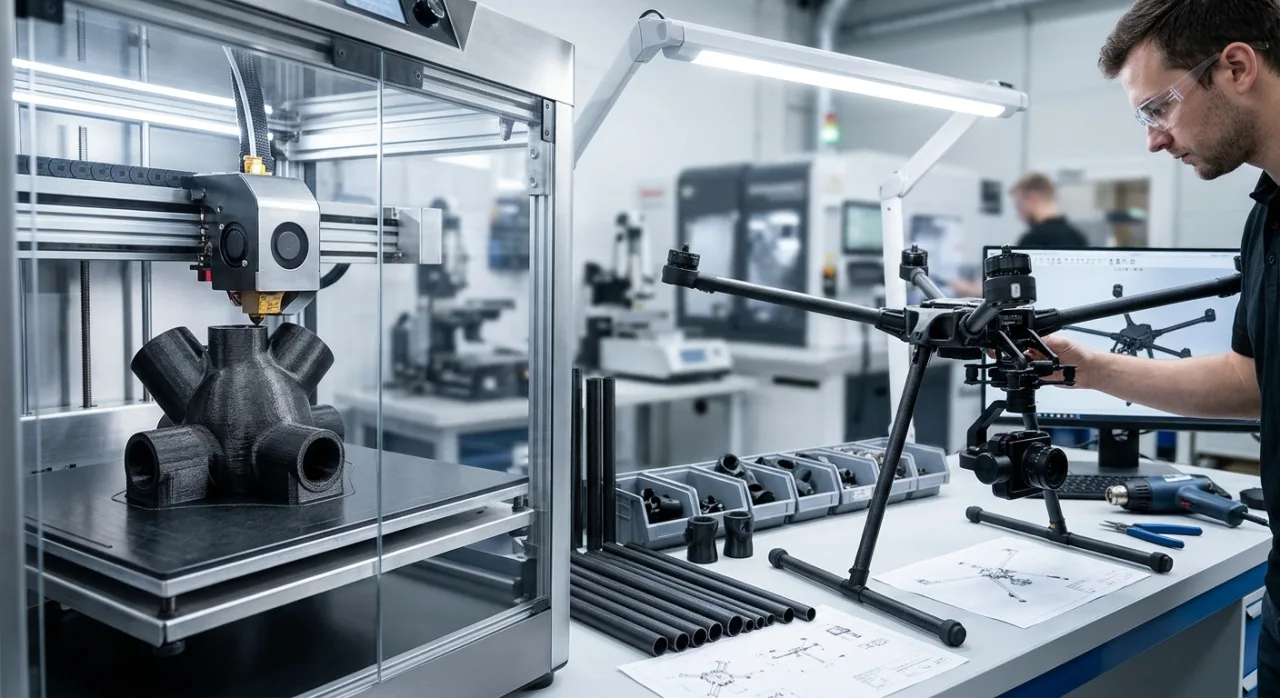
Key Advantages for Design and Engineering
Integrating carbon fiber reinforcement into 3D printing gives product designers three distinct engineering advantages:
-
Superior Strength-to-Weight Ratio: Delivers structural stiffness matching aluminum while reducing overall component weight by up to 40%.
-
Tool-Free Manufacturing: Eliminates expensive tooling, dies, and molds, allowing direct production of complex organic geometries on demand.
-
Rapid Design Iteration: Enables instant CAD adjustments engineers simply update the digital model and print the revised part immediately.
To maximize efficiency on larger structural builds, engineers frequently employ a hybrid manufacturing approach:
| Component Type | Material / Method | Function in Assembly |
| Long Spans / Beams | Stock pultruded carbon rods & composite tubes | Delivers maximum linear strength over long distances quickly and affordably. |
| Complex Nodes | Custom 3D-printed composite hubs & joints | Handles complex multi-axis geometric connections and structural mounting points. |
Revolutionizing Drones and Aerial Systems
In aerospace and unmanned aerial system (UAS) engineering, every single gram directly impacts flight endurance, payload capacity, and battery efficiency. Additive manufacturing allows drone builders to produce custom carbon fiber drone frames and optimized quadcopter and multicopter frames tailored directly to specialized mission profiles.
Rather than machining heavy aluminum brackets, developers print lightweight connection hubs that snap directly onto high-strength UAV carbon fiber arms. This modular approach creates rigid, highly crash-resistant airframes. Furthermore, custom printed mounts hold flexible carbon fiber landing gear securely in place, while dedicated brackets isolate camera gimbals from frame vibration and keep communication antennas oriented for maximum signal clarity.
Aerospace, Defense, and Deep Space Innovation
The defense and space sectors are rapidly scaling this hybrid manufacturing methodology to produce mission-critical hardware:
-
Extreme Environment Components: Advanced composite additive systems craft structural elements capable of enduring severe g-forces and launch-phase vibrational stress.
-
Thermal & RF Optimization: Specialized glass-fiber composite radome structures protect sensitive radar arrays without impeding signal clarity, while printed connectors support lightweight composite tubes designed for thermal resilience.
-
Orbital Frameworks: In satellite construction, precision 3D-printed joints link structural carbon tubing to build lightweight spaceframes that maintain strict dimensional stability across high orbital temperature swings.
Factory Automation and Industrial Robotics
Automation systems rely on rapid cycle times. On high-speed assembly lines, traditional heavy metal robotic limbs force drive motors to work harder, move slower, and suffer accelerated mechanical wear.
By replacing metallic arms with customized carbon fiber structural arms for robot assemblies, manufacturing facilities drastically decrease moving mass. Reducing payload inertia allows robotic motors to accelerate faster, consume less electrical power, and significantly extend operational lifespans.
Beyond robotics, engineers deploy durable carbon fiber structural components across high-performance automotive and industrial applications. Applications range from lightweight motorsport components like a balanced carbon fiber drive shaft to versatile field tools using multi-section printed fittings and mounts.
Frequently Asked Questions
Can 3D-printed carbon fiber replace aluminum or steel?
Yes. In non-high-temperature structural applications, carbon-reinforced 3D prints deliver tensile strength and stiffness that rival structural aluminum while cutting total component weight by 40% to 50%.
Why combine 3D-printed parts with stock carbon composite tubes?
3D printing long, continuous structural beams takes significant print time and machine capacity. By 3D printing complex, custom joints and pairing them with off-the-shelf stock carbon composite tubes or pultruded carbon rods, engineers construct large-scale frames faster while keeping material costs low.
How does carbon fiber make 3D printed parts stronger?
Microscopic chopped carbon fibers or continuous strands embedded within the thermoplastic matrix act like internal structural rebar. These fibers directly absorb tensile, bending, and torsional forces, dramatically increasing component rigidity and impact resistance.