
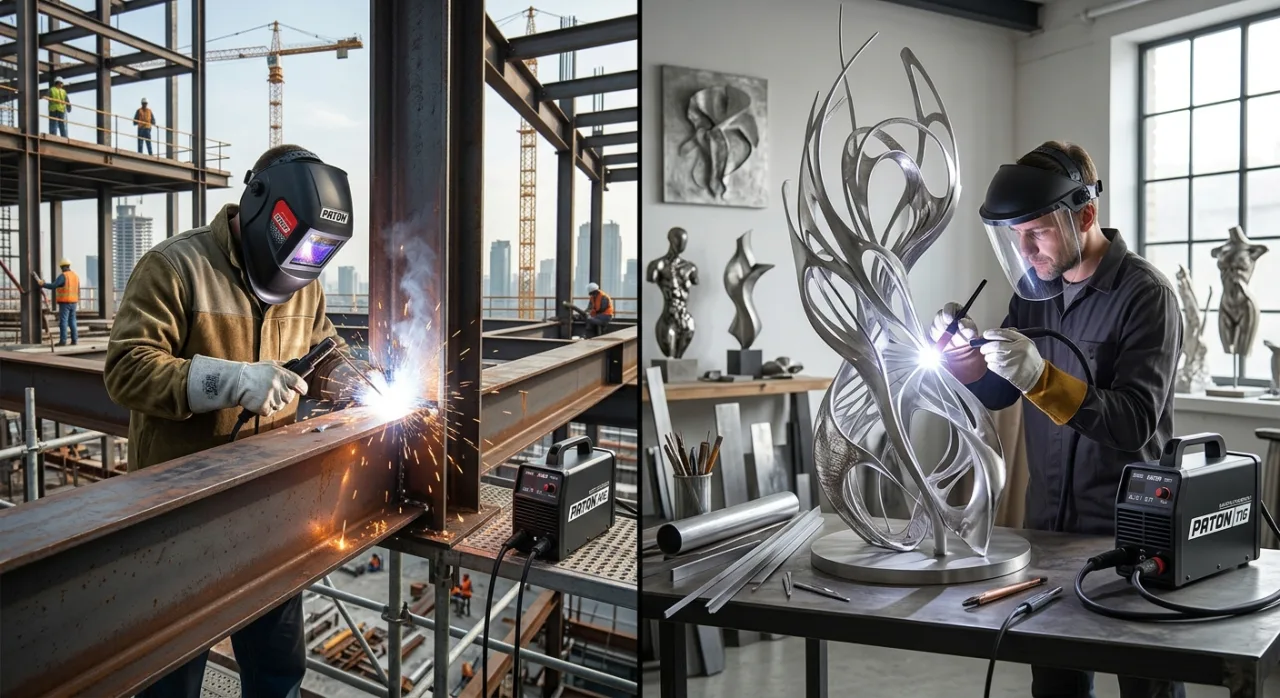
 A welder on a high-rise construction site and an artist in a design studio share a fundamental objective: melting metal using an electric arc. While their daily applications diverge, the underlying metallurgical science remains identical. Today, modern engineering has completely redefined this craft. A contemporary PATON ARC inverter welder weighs no more than a standard backpack, yet delivers the precise power required to join heavy structural steel beam frameworks and delicate metal sculptures alike.
The Birth of Electric Arc Joining
The history of electric arc welding began in 1881 when Nikolai Benardos pioneered the use of an electric arc to fuse metal plates. By 1888, Nikolai Slavyanov introduced consumable metal electrodes—a breakthrough that scaled the process for heavy industrial manufacturing and allowed welded joints to rapidly replace traditional heavy rivets in shipyards and manufacturing plants.
Scientific advancements in Ukraine played a decisive role in advancing arc technology. The E.O. Paton Electric Welding Institute pioneered automatic submerged-arc welding, enabling the continuous, consistent execution of long seams across massive infrastructure projects. This led directly to the construction of the landmark Paton Bridge across the Dnieper River in Kyiv. Opened in 1953, it remains one of the world’s most famous all-welded structural bridges.
How Inverters Replaced Heavy Transformers
For decades, traditional transformer-based welding units weighed tens of kilograms. They were notoriously noisy, prone to severe thermal overload, and vulnerable to power grid voltage fluctuations.
The advent of solid-state inverter technology permanently altered this landscape. Inverters convert standard mains power into high-frequency current, allowing engineers to dramatically shrink internal transformer components while maintaining raw output power.
Key Advantages of Inverter Technology
-
Enhanced Portability: Extremely compact dimensions and minimal physical weight.
-
Precise Current Control: Smooth, electronic regulation for high-precision heat input.
-
Voltage Stability: Reliable arc performance despite severe grid voltage fluctuations.
-
Superior Arc Control: Easy arc ignition coupled with minimal weld spatter.
-
Flexible Power Sources: Dependable operation from standard wall sockets or portable field generators.
These practical improvements allow technicians to transition seamlessly from stationary workshop environments to demanding field repairs. The welding machine is no longer a heavy, stationary fixture; it is a genuinely mobile power tool.
Energy Efficiency and Process Versatility
Modern inverter power sources eliminate wasteful electrical heat loss inherent in older transformer units, providing industrial fabrication facilities with immediate, measurable reductions in power consumption. Furthermore, integrated digital protections against thermal overload and electrical spikes protect internal circuitry and extend overall hardware service life.
Arc welding is not a single isolated method, but a versatile family of processes. Modern multi-process power units integrate several core techniques into a single, compact chassis:
| Welding Method | Full Name | Primary Strengths & Ideal Applications |
| MMA | Shielded Metal Arc Welding | Simple, robust, and performs exceptionally well outdoors in windy environments. |
| MIG/MAG | Gas Metal Arc Welding | High-speed continuous wire feeding optimized for high-volume workshop production. |
| TIG | Gas Tungsten Arc Welding | Delivers exceptionally clean, high-integrity weld seams on thin-gauge metals. |
| Plasma | Plasma Arc Cutting | Delivers high-speed, high-precision thermal cutting across diverse alloy types. |
Multi-mode units enable operators to alternate between distinct metal-joining tasks without purchasing, storing, and maintaining separate specialized machines. This versatility provides maximum ROI for small fabrication shops, repair yards, and mobile service crews.
Selecting the Right Process for the Job
Selecting the ideal welding process depends entirely on material alloy, thickness, and operating environment:
-
Outdoor Field & Construction Work: MMA remains the default choice because flux-coated electrodes withstand surface contamination, light rust, and strong crosswinds.
-
High-Volume Factory Production: MIG/MAG maximizes efficiency and speeds up production lines.
-
Precision Metal Fabrication: TIG provides the fine thermal control necessary for stainless steel, aluminum, and thin-walled tubing.
This exact current control gives modern sculptors and architectural designers total confidence when working with intricate metal sheets and fine tubing. A discipline once reserved for massive cargo ships and heavy infrastructure now regularly creates custom furniture, interior architectural features, and public art installations.
Over a century and a half, arc welding evolved from an experimental laboratory demonstration into an indispensable technology powering modern construction, manufacturing, and design.